
Health & Fitness Sicence Associate in Applied Science (A45630)

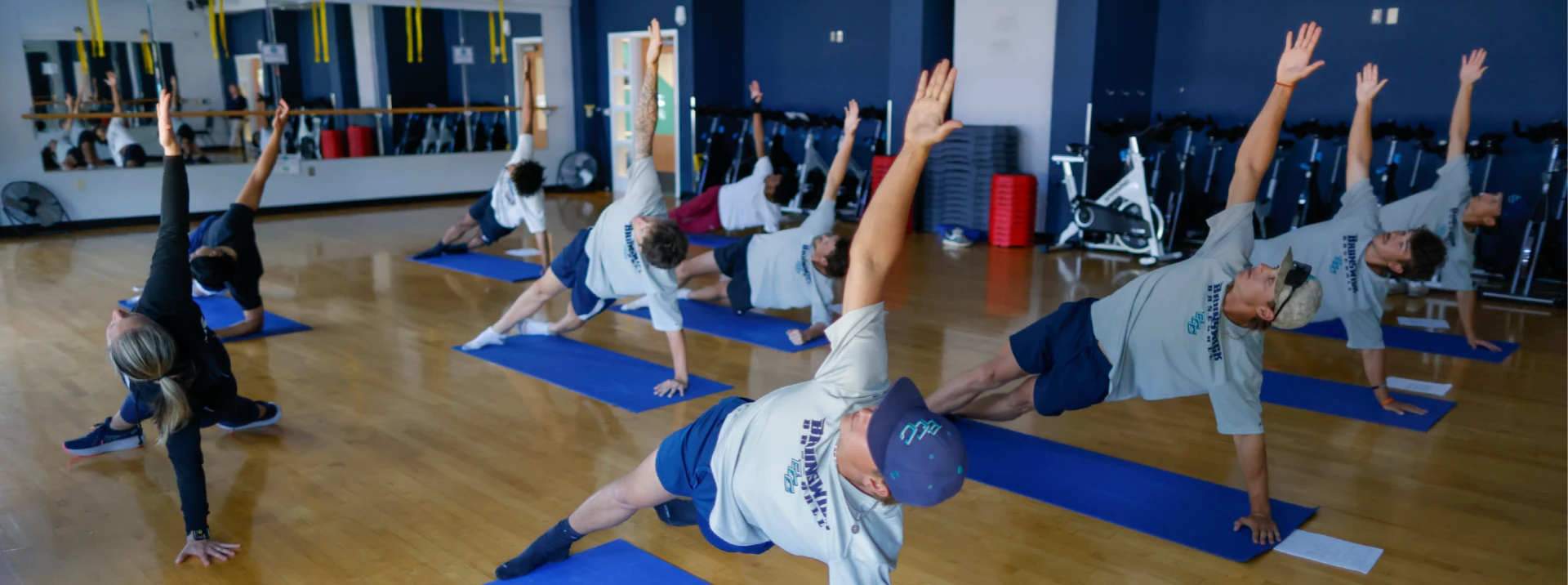
The Health and Fitness Science program is designed to provide students with the knowledge and skills necessary for employment in the fitness and exercise industry.

Students will be trained in exercise science and be able to administer basic fitness tests and health risk appraisals, teach specific exercise and fitness classes, and provide instruction in the proper use of exercise equipment and facilities. Graduates should qualify for employment opportunities in commercial fitness clubs, YMCA’s/YWCA’s, well programs in business and industry, Parks & Recreation Departments, and other organizations implementing exercise and fitness programs.

BCC also offers Health & Fitness Science, Athletic Training, Health Promotions, Health and Wellness Management, Sports Officiating, and Public Heath Certificate options.

Semesters

Saved courses will be emailed to you. Click the ribbon after each title to select.

Class room image
First Fall Semester

Transfer and Career Success

This course provides information and strategies necessary to develop clear academic and professional goals beyond the community college experience. Topics include the CAA, college policies and culture, career exploration, gathering information on senior institutions, strategic planning, critical thinking, and communications skills for a successful academic transition. Upon completion, students should be able to develop an academic plan to transition successfully to senior institutions. This course has been approved for transfer under the CAA and ICAA as a pre-major and/or elective course requirement for the AA, AE, & AS degrees.

ACA 122

Credits: 1
Lab: 2

Anatomy & Physiology I

This course provides a comprehensive study of the anatomy and physiology of the human body. Topics include body organization, homeostasis, cytology, histology, and the integumentary, skeletal, muscular, and nervous systems and special senses. Upon completion, students should be able to demonstrate an in-depth understanding of principles of anatomy and physiology and their interrelationships. This course has been approved for transfer under the CAA and ICAA as a pre-major and/or elective course requirement for the AA & AS degree.

BIO 168

Prerequisites:

ENG 025

This course provides the skills necessary for success in college English courses. Topics include reading and writing processes and strategies, such as critical thinking, text analysis, idea development, and application of writing conventions. Upon completion, students should be able to analyze readings and produce unified, coherent, well developed paragraphs and essays using appropriate document design and standard written English while developing positive academic habits, learning strategies, and a growth mindset.

Length: 3
Credits: 4
Lecture: 3
Lab: 3

Writing and Inquiry

This course is designed to develop the ability to produce clear writing in a variety of genres and formats using a recursive process. Emphasis includes inquire, analysis, effective use of rhetorical strategies, thesis development, audience awareness, and revision. Upon completion, students should be able to produce unified, coherent, well-developed essays using standard written English. This course has been approved for transfer under the CAA and ICAA as a pre-major and/or general education elective course requirement for the AA, AS or AE degrees. This is a Universal General Education Transfer Component (UGETC) course in English Composition for the AA, AE, and AS degrees.

ENG 111

Prerequisites:

ENG 025

This course provides the skills necessary for success in college English courses. Topics include reading and writing processes and strategies, such as critical thinking, text analysis, idea development, and application of writing conventions. Upon completion, students should be able to analyze readings and produce unified, coherent, well developed paragraphs and essays using appropriate document design and standard written English while developing positive academic habits, learning strategies, and a growth mindset.

Length: 3
Credits: 3
Lecture: 3

Exercise Science

This course is a survey of scientific principles, methodologies, and research as applied to exercise and physical adaptations to exercise. Topics include the basic elements of kinesiology, biomechanics, and motor learning. Upon completion, students should be able to identify and describe physiological responses and adaptations to exercise.

HFS 110

Credits: 4
Lecture: 4

Quantitative Literacy

This course is designed to engage students in complex and realistic situations involving the mathematical phenomena of quantity, change and relationship, and uncertainty through project- and activity-based assessment. Emphasis is placed on authentic contexts which will introduce the concepts of numeracy, proportional reasoning, dimensional analysis, rates of growth, personal finance, consumer statistics, practical probabilities, and mathematics for citizenship. Upon completion, students should be able to utilize quantitative information as consumers and to make personal, professional, and civic decisions by decoding, interpreting, using, and communicating quantitative information found in modern media and encountered in everyday life. This course has been approved for transfer under the CAA and ICAA as a general education course in Mathematics (Quantitative) for the AA & AS degrees. This is a Universal General Education Transfer Component (UGETC) course in Mathematics (Quantitative) for the AA degree ONLY.

MAT 143

Prerequisites:

MAT 035

This course covers algebraic concepts with an emphasis on application and analysis. Topics include rational/radical expressions and equations, solving equations and inequalities, concepts of functions, factoring, and exponents. Upon completion, students should be able to successfully demonstrate mastery of algebraic concepts through application and analysis while developing positive academic habits, learning strategies and growth mindset.

Length: 2
Credits: 3
Lecture: 2
Lab: 2

PED 110

This course is designed to investigate and apply the basic concepts and principles of lifetime physical fitness and other health-related factors. Emphasis is placed on wellness through the study of nutrition, weight control, stress management, and consumer facts on exercise and fitness. Upon completion, students should be able to plan a personal, lifelong fitness program based on individual needs, abilities, and interests. This course has been approved for transfer under the CAA and ICAA as a pre-major and/or elective course requirement for the AA, AE, & AS degrees.

OR

HEA 110

This course provides an introduction to basic personal health and wellness. Emphasis is placed on current health issues such as nutrition, mental health, and fitness. Upon completion, students should be able to demonstrate an understanding of the factors necessary to the maintenance of health and wellness. This course has been approved for transfer under the CAA and ICAA as a pre-major and/or elective course requirement for the AA & AS degrees.

Credit: 2-3
Semester Total 17-18
First Spring Semester

Nutrition

This course covers the biochemistry of foods and nutrients with consideration of the physiological effects of specialized diets for specific biological needs. Topics include cultural, religious, and economic factors that influence a person’s acceptance of food, as well as nutrient requirements of the various life stages. Upon completion, students should be able to identify the functions and sources of nutrients, the mechanisms of digestion, and the nutritional requirements of all age groups. This course has been approved for transfer under the CAA and ICAA as a pre-major and/or elective course requirement for the AA & AS degree.

BIO 155

Length: 3
Credits: 3
Lecture: 3

Anatomy & Physiology II

This course provides a continuation of the comprehensive study of the anatomy and physiology of the human body. Topics include the endocrine, cardiovascular, lymphatic, respiratory, digestive, urinary, and reproductive systems as well as metabolism, nutrition, acid-base balance, and fluid and electrolyte balance. Upon completion, students should be able to demonstrate an in-depth understanding of principles of anatomy and physiology and their interrelationships. This course has been approved for transfer under the CAA and ICAA as a pre-major and/or elective course requirement for the AA & AS degree.

BIO 169

Prerequisites:

BIO 168

This course provides a comprehensive study of the anatomy and physiology of the human body. Topics include body organization, homeostasis, cytology, histology, and the integumentary, skeletal, muscular, and nervous systems and special senses. Upon completion, students should be able to demonstrate an in-depth understanding of principles of anatomy and physiology and their interrelationships. This course has been approved for transfer under the CAA and ICAA as a pre-major and/or elective course requirement for the AA & AS degree.

, minimum Grade of “C”
Length: 3
Credits: 4
Lecture: 3
Lab: 3

Introduction to Computers

This course introduces computer concepts, including fundamental functions and operations of the computer. Topics include identification of hardware components, basic computer operations, security issues, and use of software applications. Upon completion, students should be able to demonstrate an understanding of the role and function of computers and use the computer to solve problems. This course has been approved for transfer under the CAA and ICAA as a general education course in Mathematics (Quantitative Option) in the AA & AS degrees.

CIS 110

Length: 2
Credits: 3
Lecture: 2
Lab: 2

Fitness & Exercise Testing I

This course introduces the student to graded exercise testing. Topics include various exercise testing protocols with methods for prescribing exercise programs based on exercise tolerance tests and the use of various equipment and protocols. Upon completion, students should be able to conduct specific exercise tests and the use of various equipment.

HFS 111

Length: 3
Credits: 4
Lecture: 3
Lab: 2

Prevention & Care of Exercise Injuries

This course provides information about the care and prevention of exercise injuries. Topics include proper procedures, prevention techniques, and on- site care of injuries. Upon completion, students should be able to demonstrate the knowledge and skills necessary to prevent and care for exercise related injuries.

HFS 116

Length: 2
Credits: 3
Lecture: 2
Lab: 2
Semester Total 17
Second Fall Semester

Public Speaking

This course provides instruction and experience in preparation and delivery of speeches within a public setting and group discussion. Emphasis is placed on research, preparation, delivery, and evaluation of informative, persuasive, and special occasion public speaking. Upon completion, students should be able to prepare and deliver well-organized speeches and participate in group discussion with appropriate audiovisual support. This course has been approved for transfer under the CAA and ICAA as a general education course in English Composition Communications) for the AA & AS degrees. This is a Universal General Education Transfer Component (UGETC) course in Communications for the AA & AS degrees.

COM 231

Length: 3
Credits: 3
Lecture: 3

CPR & First Aid

This course introduces the basics of emergency first aid treatment. Topics include rescue breathing, CPR, first aid for choking and bleeding, and other first aid procedures. Upon completion, students should be able to demonstrate skills in providing emergency care for the sick and injured until medical help can be obtained. This course has been approved for transfer under the CAA and ICAA as a pre- major and/or elective course requirement for the AA & AS degrees.

HEA 112

Length: 1
Credits: 2
Lecture: 1
Lab: 2

Group Exercise Instruction

This course introduces the concepts and guidelines of instructing exercise classes. Topics include program designs, working with special populations, and principles of teaching and monitoring physical activity. Upon completion, students should be able to demonstrate basic skills in instructing an exercise class and monitoring workout intensity.

HFS 120

Prerequisites:

HFS 110

This course is a survey of scientific principles, methodologies, and research as applied to exercise and physical adaptations to exercise. Topics include the basic elements of kinesiology, biomechanics, and motor learning. Upon completion, students should be able to identify and describe physiological responses and adaptations to exercise.

Length: 2
Credits: 3
Lecture: 2
Lab: 2

Health & Fitness Law

This course is designed to build a greater awareness and understanding of laws and legal issues encountered in the health and fitness industry. Topics include federal/state regulations, historical/current practices, risk management, torts, employment, discrimination, contracts, waivers, health/ fitness screening, client confidentiality, facility safety, equipment liability, and emergency procedures. Upon completion, students should be able to demonstrate an understanding of the legal system to prevent or minimize liability in a fitness setting.

HFS 214

Length: 3
Credits: 3
Lecture: 3

Lifestyle Change & Wellness

This course introduces health risk appraisals and their application to lifestyle changes. Topics include nutrition, weight control, stress management, and the principles of exercise. Upon completion, students should be able to conduct health risk appraisals and apply behavior modification techniques in a fitness setting.

HFS 218

Length: 3
Credits: 4
Lecture: 3
Lab: 2
Semester Total 15
Second Spring Semester

Fitness Facility Management

This course provides information about the management and operation of health and fitness facilities and programs. Topics include human resources, sales and marketing, member retention, financial management, facility design and maintenance, and risk management. Upon completion, students should be able to demonstrate the knowledge and skills necessary to effectively manage a fitness facility.

HFS 118

Length: 4
Credits: 4
Lecture: 4

Personal Training

This course introduces the student to the aspects of personal (one- on- one) training. Topics include training systems, marketing, and program development. Upon completion, students should be able to demonstrate personal training techniques and competencies of same.

HFS 210

Prerequisites:

HFS 110

This course is a survey of scientific principles, methodologies, and research as applied to exercise and physical adaptations to exercise. Topics include the basic elements of kinesiology, biomechanics, and motor learning. Upon completion, students should be able to identify and describe physiological responses and adaptations to exercise.

and

HFS 111

This course introduces the student to graded exercise testing. Topics include various exercise testing protocols with methods for prescribing exercise programs based on exercise tolerance tests and the use of various equipment and protocols. Upon completion, students should be able to conduct specific exercise tests and the use of various equipment.

Length: 2
Credits: 3
Lecture: 2
Lab: 2

Exercise Programming

This course provides information about organizing, scheduling, and implementation of physical fitness programs. Topics include programming for various age groups, competitive activities and special events, and evaluating programs. Upon completion, students should be able to organize and implement exercise activities in a competent manner.

HFS 212

Prerequisites:

HFS 110

This course is a survey of scientific principles, methodologies, and research as applied to exercise and physical adaptations to exercise. Topics include the basic elements of kinesiology, biomechanics, and motor learning. Upon completion, students should be able to identify and describe physiological responses and adaptations to exercise.

Length: 2
Credits: 3
Lecture: 2
Lab: 2

General Psychology

This course provides an overview of the scientific study of human behavior. Topics include history, methodology, biopsychology, sensation, perception, learning, motivation, cognition, abnormal behavior, personality theory, social psychology, and other relevant topics. Upon completion, students should be able to demonstrate a basic knowledge of the science of psychology. This course has been approved for transfer under the CAA and ICAA as a pre-major and/or elective course requirement for the AA, AE, & AS degrees. This is a Universal General Education Transfer Component (UGETC) course in Social & Behavioral Sciences for the AA, AE, & AS degrees.

PSY 150

Prerequisites:

ENG 025

This course provides the skills necessary for success in college English courses. Topics include reading and writing processes and strategies, such as critical thinking, text analysis, idea development, and application of writing conventions. Upon completion, students should be able to analyze readings and produce unified, coherent, well developed paragraphs and essays using appropriate document design and standard written English while developing positive academic habits, learning strategies, and a growth mindset.

Length: 3
Credits: 3
Lecture: 3

WBL 111

This course provides a work-based learning experience with a college- approved employer in an area related to the student’s program of study. Emphasis is placed on integrating classroom learning with related work experience. Upon completion, students should be able to evaluate career selection, demonstrate employability skills, and satisfactorily perform work- related competencies.

OR

BUS 137

This course is designed to be an overview of the major functions of management. Emphasis is placed on planning, organizing, controlling, directing, and communicating. Upon completion, students should be able to work as contributing members of a team utilizing these functions of management. This course has been approved for transfer under the CAA and ICAA as a pre-major and/or elective course requirement for the AA & AS degrees.

Credit: 1-3

Humanities/Fine Arts Elective

ART 111

This course introduces the origins and historical development of art.  Emphasis is placed on the relationship of design principles to various art forms, including but not limited to, sculpture, painting, and architecture. Upon completion, students should be able to identify and analyze a variety of artistic styles, periods, and media. This course has been approved for transfer under the CAA and ICAA as a pre-major and/or general education elective course requirement for the AA, AE, & AS degrees.  This is a Universal General Education Transfer Component (UGETC) course in Humanities & Fine Arts for the AA, AE, & AS degrees.

,

ART 114

This course covers the development of art forms from ancient times to the Renaissance. Emphasis is placed on content, terminology, design, and style. Upon completion, students should be able to demonstrate a historical understanding of art as a product reflective of human social development.  This course has been approved for transfer under the CAA and ICAA as a pre-major and/or general education elective course requirement for the AA, AE, & AS degrees. This is a Universal General Education Transfer Component (UGETC) course in Humanities & Fine Arts for the AA, AE, & AS degrees.

,

ART 115

This course covers the development of art forms from the Renaissance to the present. Emphasis is placed on content, terminology, design, and style. Upon completion, students should be able to demonstrate a historical understanding of art as a product reflective of human social development. This course has been approved for transfer under the CAA and ICAA as a pre-major and/or general education elective course requirement for the AA, AE, & AS degrees. This is a Universal General Education Transfer Component (UGETC) course in Humanities & Fine Arts for the AA, AE, & AS degrees.

,

ART 121

This course introduces the elements and principles of design as applied to two-dimensional art. Emphasis is placed on the structural elements, the principles of visual organization, and the theories of color mixing and interaction. Upon completion, students should be able to understand and use critical and analytical approaches as they apply to two-dimensional visual art. This course has been approved for transfer under the CAA and ICAA as a pre-major and/or elective course requirement in Humanities and Fine Arts for the AA & AS degrees.

,

ART 131

This course introduces the language of drawing and the use of various drawing materials. Emphasis is placed on drawing techniques, media, and graphic principles. Upon completion, students should be able to demonstrate competence in the use of graphic forms and various drawing processes. This course has been approved for transfer under the CAA and ICAA as a pre-major and/or elective course requirement in Humanities and Fine Arts for the AA & AS degrees.

,

DAN 110

This course for non-dance majors surveys diverse dance forms and the religious and cultural values that shape them. Topics include dances from Europe, Africa, Asia, and America. Upon completion, students should be able to demonstrate an understanding of the diverse forms and values that dance embraces. This course has been approved for transfer under the CAA and ICAA as a general education course in Humanities & Fine Arts for the AA & AS degrees.

,

MUS 110

This course is a basic survey of the music of the Western world. Emphasis is placed on the elements of music, terminology, composers, form, and style within a historical perspective. Upon completion, students should be able to demonstrate skills in basic listening and understanding of the art of music. This course has been approved for transfer under the CAA and ICAA as a pre-major and/or elective course requirement for the AA, AE, & AS degrees. This is a Universal General Education Transfer Component (UGETC) course in Humanities & Fine Arts for the AA, AE, & AS degrees.

,

MUS 111

This course is an introductory course for students with little or no music background. Emphasis is placed on music notation, rhythmic patterns, scales, key signatures, intervals, and chords. Upon completion, students should be able to demonstrate an understanding of the rudiments of music. This course has been approved for transfer under the CAA and ICAA as a pre-major and/or elective course requirement for the AA & AS degrees.

,

MUS 112

This course introduces the origins and musical components of jazz and the contributions of its major artists. Emphasis is placed on the development of discriminating listening habits, as well as the investigation of the styles and structural forms of the jazz idiom. Upon completion, students should be able to demonstrate skills in listening and understanding this form of American music. This course has been approved for transfer under the CAA and ICAA as a pre-major and/or elective course requirement for the AA & AS degrees. This is a Universal General Education Transfer Component (UGETC) course in Humanities & Fine Arts for the AA & AS degrees.

,

PHI 215

This course introduces fundamental issues in philosophy considering the views of classical and contemporary philosophers. Emphasis is placed on knowledge and belief, appearance and reality, determinism and free will, faith and reason, and justice and inequality. Upon completion, students should be able to identify, analyze, and critically evaluate the philosophical components of an issue. This course has been approved for transfer under the CAA and ICAA as a pre-major and/or elective course requirement for the AA, AE, & AS degrees. This is a Universal General Education Transfer Component (UGETC) course in Humanities & Fine Arts for the AA, AE, & AS degrees.

,

PHI 240

This course introduces theories about the nature and foundations of moral judgments and applications to contemporary moral issues. Emphasis is placed on moral theories such as consequentialism, deontology, and virtue ethics. Upon completion, students should be able to apply various ethical theories to moral issues such as abortion, capital punishment, poverty, war, terrorism, the treatment of animals, and issues arising from new technologies. This course has been approved for transfer under the CAA and ICAA as a pre-major and/or elective course requirement for the AA, AE & AS degrees. This is a Universal General Education Transfer Component (UGETC) course in Humanities & Fine Arts for the AA & AE degrees.

,

REL 110

This course introduces the world’s major religious traditions. Topics include Primal religions, Hinduism, Buddhism, Islam, Judaism, and Christianity. Upon completion, students should be able to identify the origins, history, beliefs, and practices of the religions studied. This course has been approved for transfer under the CAA and ICAA as a general education course in Humanities & Fine Arts for the AA, AE, & AS degrees.

,

REL 211

This course is a survey of the literature of the Hebrews with readings from the law, prophets, and other writings. Emphasis is placed on the use of literary, historical, archeological, and cultural analysis. Upon completion, students should be able to use the tools of critical analysis to read and understand Old Testament literature. This course has been approved for transfer under the CAA and ICAA as a general education course in Humanities & Fine Arts for the AA & AS degrees.

,

REL 212

This course is a survey of the literature of first-century Christianity with readings from the gospels, Acts, and the Pauline and pastoral letters. Topics include the literary structure, audience, and religious perspective of the writings, as well as the historical and cultural context of the early Christian community. Upon completion, students should be able to use the tools of critical analysis to read and understand New Testament literature.  This course has been approved for transfer under the CAA and ICAA as a general education course in Humanities & Fine Arts for the AA & AS degrees.

or

REL 221

This course is an examination of religious beliefs and practice in the United States. Emphasis is placed on mainstream religious traditions and non- traditional religious movements from the Colonial period to the present. Upon completion, students should be able to recognize and appreciate the diversity of religious traditions in America. This course has been approved for transfer under the CAA and ICAA as a general education course in Humanities & Fine Arts for the AA & AS degrees.

Credit: 3
Semester Total 17-19
Total Program Credit 66-69
BrunswickComCol_WebsiteAsset_FlowerLady_HeadRoom
BrunswickComCol_WebsiteAsset_Mobile_Trophy_HeadRoom

STUDENT STORY

Caroline Bailey

Congratulations to Caroline Bailey for being named as a BCC Student of the Month. “In every way, Caroline represents the best of BCC,” said Instructor Heather Hardie. “She’s a team player, hard worker, and has a heart of gold. Her passion for learning and helping others inspires us all.”

Find your path

Need Help Choosing?

Not sure which program is right for you? Our Success Coaches are here to help.

OneStop Student Services, Building A, Brunswick Community College

(910) 755-7320 | onestop@brunswickcc.edu

Close

TELL US ABOUT YOURSELF.

WHAT INTERESTS YOU? (CHOOSE UP TO 3)

WHAT CREDENTIAL ARE YOU HOPING TO EARN?

In about two years, you can earn an Associate of Arts, Associate of Science, or an Associate of Applied Science degree. Many students continue their education at a four-year college or university.
A diploma takes less time (9-18 months) than a degree and provides you with hands-on training and skills in a specific field. You are workforce ready.
If you want focused training in a specific skill or industry in less than one year, a certificate program may be for you.
In less than six months, you train for employment in a specific field or career type, short-term industry training programs are a great place to start. Some programs offer industry recognized credentials.
High School students can accelerate the completion of college certificates, diplomas, and associate degrees.
Complete a high school credential (GED®) that mirrors a public-school credential.
Prepares adults to take the High School Equivalency Test.

HOW WOULD YOU PREFER TO LEARN?

WHEN WOULD YOU LIKE TO COMPLETE YOUR PROGRAM?

BASED ON YOUR RESPONSES, THESE PROGRAMS MAY BE A GREAT FIT FOR YOU.

Every student's path is different. Explore these recommended programs to learn more about the opportunities available at Brunswick Community College.

Find your pathways and take the next step forward

Wherever you’re starting, we’re here to help you take the next step.

Pathways Wizard is your personal academic navigator—helping you map out the right path to reach your goals and turn confusion into a clear plan forward.