

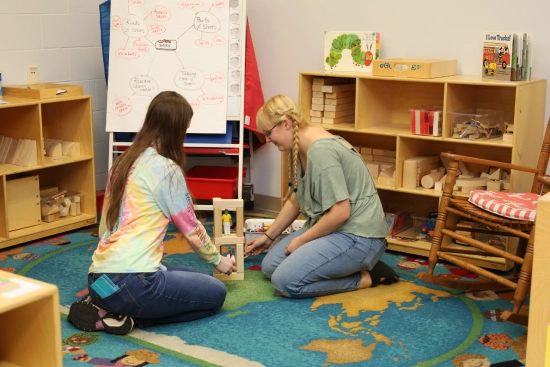

Early Childhood Education Birth Kindergarten Teaching Licensure Image
small-image

Birth-Kindergarten (B-K) Teaching Licensure Associate in Applied Science Degree (A55220L)

The Early Childhood Education curriculum prepares individuals to work with children from birth through eight in diverse learning environments. Students will combine learned theories with practice in actual settings with young children under the supervision of qualified teachers.

Coursework includes child growth and development; physical/nutritional needs of children; care and guidance of children; and communication skills with families and children. Students will foster the cognitive/language, physical/motor, social/emotional, and creative development of young children.

Graduates are prepared to plan and implement developmentally appropriate programs in early childhood settings. Employment opportunities include child development and child care programs, preschools, public and private schools, recreational centers, Head Start Programs, and school-age programs.

Leading to the Associate in Science Teacher Preparation Image

Semesters

Saved courses will be emailed to you. Click the ribbon after each title to select.

Class room image
First Fall Semester

Transfer and Career Success

This course provides information and strategies necessary to develop clear academic and professional goals beyond the community college experience. Topics include the CAA, college policies and culture, career exploration, gathering information on senior institutions, strategic planning, critical thinking, and communications skills for a successful academic transition. Upon completion, students should be able to develop an academic plan to transition successfully to senior institutions. This course has been approved for transfer under the CAA and ICAA as a pre-major and/or elective course requirement for the AA, AE, & AS degrees.

ACA 122

Credits: 1
Lab: 2

Intro to Early Childhood Education

This course introduces the foundations of culturally responsive, equitable and inclusive early childhood education, planning intentional developmentally appropriate experiences, learning activities, and teaching strategies for indoor and outdoor environments for all young children, guidance techniques, and professionalism. Topics include theoretical foundations, national early learning standards, NC Foundations for Early Learning and Development, state regulations, program types, career options, professionalism, ethical conduct, quality inclusive environments, guidance techniques, and curriculum responsive to the needs of each child/family. Upon completion, students should be able to implement developmentally appropriate environments, guidance techniques, schedules, and teaching strategies across developmental domains to support culturally, linguistically, and ability diverse children and their families in inclusive settings, and design a personal career/professional development plan.

EDU 119

Length: 4
Credits: 4
Lecture: 4

Child, Family, & Community

This course covers the development of partnerships among culturally, linguistically and ability diverse families, children, schools and communities through the use of evidence-based strategies. Emphasis is placed on developing skills and identifying benefits for establishing and supporting respectful relationships between diverse families, programs/schools, and community agencies/resources reflective of the NAEYC Code of Ethical Conduct and the Code of Ethics for North Carolina Educators. Upon completion, students should be able to identify appropriate relationship building strategies between diverse families, children birth through adolescence, schools, and communities and demonstrate a variety of communication skills including appropriate use of technology to support every child.

EDU 131

Length: 3
Credits: 3
Lecture: 3

Child Guidance

This course provides an activity-based approach that develops measurement skills and mathematical literacy using technology to solve problems for non-math intensive programs. Topics include unit conversions and estimation within a variety of measurement systems; ratio and proportion; basic geometric concepts; financial literacy; and statistics including measures of central tendency, dispersion, and charting of data. Upon completion, students should be able to demonstrate the use of mathematics and technology to solve practical problems, and to analyze and communicate results.

EDU 146

Length: 2
Credits: 3
Lecture: 2
Lab: 2

Health, Safety, & Nutrition

This course covers promoting and maintaining the health and well-being of every child. Topics include health and nutritional guidelines, common childhood illnesses, maintaining safe and healthy learning environments, health benefits of active play, recognition and reporting of abuse/neglect, and state regulations. Upon completion, students should be able to apply knowledge of NC Foundations for Early Learning and Development for health, safety, nutritional needs and safe learning environments.

EDU 153

Length: 3
Credits: 3
Lecture: 3

Writing and Inquiry

This course is designed to develop the ability to produce clear writing in a variety of genres and formats using a recursive process. Emphasis includes inquire, analysis, effective use of rhetorical strategies, thesis development, audience awareness, and revision. Upon completion, students should be able to produce unified, coherent, well-developed essays using standard written English. This course has been approved for transfer under the CAA and ICAA as a pre-major and/or general education elective course requirement for the AA, AS or AE degrees. This is a Universal General Education Transfer Component (UGETC) course in English Composition for the AA, AE, and AS degrees.

ENG 111

Prerequisites:

ENG 025

This course provides the skills necessary for success in college English courses. Topics include reading and writing processes and strategies, such as critical thinking, text analysis, idea development, and application of writing conventions. Upon completion, students should be able to analyze readings and produce unified, coherent, well developed paragraphs and essays using appropriate document design and standard written English while developing positive academic habits, learning strategies, and a growth mindset.

Length: 3
Credits: 3
Lecture: 3
Semester Total 17
First Spring Semester

Child Development I

This course includes the theories of child development, observation and assessment, milestones, and factors that influence development, from conception through approximately 36 months. Emphasis is placed on knowledge, observation and assessment of developmental sequences in approaches to play/learning, emotional/social, health/physical, language/communication and cognitive domains. Upon completion, students should be able to compare/contrast typical/atypical developmental characteristics, explain biological and environmental factors that impact development, and identify evidence-based strategies for enhancing development for children that are culturally, linguistically, and ability diverse. This course has been approved for transfer under the CAA and ICAA as a pre-major and/or elective course requirement or the AA & AS degrees.

EDU 144

Length: 3
Credits: 3
Lecture: 3

Child Development II

This course includes the theories of child development, observation and assessment, milestones, and factors that influence development, from preschool through middle childhood. Emphasis is placed on knowledge, observation and assessment of developmental sequences in approaches to play/learning, emotional/social, health/physical, language/communication and cognitive domains. Upon completion, students should be able to compare/contrast typical/atypical developmental characteristics, explain biological and environmental factors that impact development and identify evidence-based strategies for enhancing development for children that are culturally, linguistically, and ability diverse. This course has been approved for transfer under the CAA and ICAA as a pre-major and/or elective course requirement or the AA & AS degrees.

EDU 145

Length: 3
Credits: 3
Lecture: 3

Creative Activities

This course introduces developmentally supportive creative learning environments with attention to divergent thinking, creative problem-solving, evidence-based teaching practices, and open-ended learning materials while applying NC Foundations for Early Learning and Development. Emphasis is placed on observation of process driven learning experiences in art, music, creative movement, dance, and dramatics for every young child age birth through eight, integrated through all domains and academic content. Upon completion, students should be able to examine, create, and adapt developmentally creative learning materials, experiences, and environments for children that are culturally, linguistically, and ability diverse.

EDU 151

Length: 3
Credits: 3
Lecture: 3

Quantitative Literacy

This course is designed to engage students in complex and realistic situations involving the mathematical phenomena of quantity, change and relationship, and uncertainty through project- and activity-based assessment. Emphasis is placed on authentic contexts which will introduce the concepts of numeracy, proportional reasoning, dimensional analysis, rates of growth, personal finance, consumer statistics, practical probabilities, and mathematics for citizenship. Upon completion, students should be able to utilize quantitative information as consumers and to make personal, professional, and civic decisions by decoding, interpreting, using, and communicating quantitative information found in modern media and encountered in everyday life. This course has been approved for transfer under the CAA and ICAA as a general education course in Mathematics (Quantitative) for the AA & AS degrees. This is a Universal General Education Transfer Component (UGETC) course in Mathematics (Quantitative) for the AA degree ONLY.

MAT 143

Prerequisites:

MAT 035

This course covers algebraic concepts with an emphasis on application and analysis. Topics include rational/radical expressions and equations, solving equations and inequalities, concepts of functions, factoring, and exponents. Upon completion, students should be able to successfully demonstrate mastery of algebraic concepts through application and analysis while developing positive academic habits, learning strategies and growth mindset.

Length: 2
Credits: 3
Lecture: 2
Lab: 2

Writing/Research in the Disciplines

This course, the second in a series of two, introduces research techniques, documentation styles, and writing strategies. Emphasis is placed on analyzing information and ideas and incorporating research findings into documented writing and research projects. Upon completion, students should be able to evaluate and synthesize information from primary and secondary sources using documentation appropriate to various disciplines. This course has been approved for transfer under the CAA and ICAA as a pre-major and/or general education elective course requirement for the AA, AS or AE degrees. This is a Universal General Education Transfer Component (UGETC) course in English Composition for the AA, AE, and AS degrees.

ENG 112

Prerequisites:

ENG 111

This course is designed to develop the ability to produce clear writing in a variety of genres and formats using a recursive process.  Emphasis includes inquire, analysis, effective use of rhetorical strategies, thesis development, audience awareness, and revision. Upon completion, students should be able to produce unified, coherent, well-developed essays using standard written English. This course has been approved for transfer under the CAA and ICAA as a pre-major and/or general education elective course requirement for the AA, AS or AE degrees. This is a Universal General Education Transfer Component (UGETC) course in English Composition for the AA, AE, and AS degrees.

Length: 3
Credits: 3
Lecture: 3
Semester Total 15
First Summer Semester

Natural Science Elective

CHM 151

This course covers fundamental principles and laws of chemistry. Topics include measurement, atomic and molecular structure, periodicity, chemical reactions, chemical bonding, stoichiometry, thermochemistry, gas laws, and solutions. Upon completion, students should be able to demonstrate an understanding of fundamental chemical laws and concepts as needed inCHM 152. This course has been approved for transfer under the CAA and ICAA as a general education course in Natural Science for the AA & AS degrees. This is a Universal General Education Transfer Component (UGETC) course in Natural Sciences for the AA & AS degrees.

,

GEL 111

This course introduces basic landforms and geological processes. Topics include rocks, minerals, volcanoes, fluvial processes, geological history, plate tectonics, glaciers, and coastal dynamics. Upon completion, students should be able to describe basic geological processes that shape the earth. This course has been approved for transfer under the CAA and ICAA as a general education course in Social & Behavioral Sciences for the AA & AS degrees. This is a Universal General Education Transfer Component (UGETC) course in Natural Sciences for the AA & AS degrees.

AND

PHY 110

This course provides a conceptually-based exposure to the fundamental principles and processes of the physical world. Topics include basic concepts of motion, forces, energy, heat, electricity, magnetism, and the structure of matter and the universe. Upon completion, students should be able to describe examples and applications of the principles studied.  This course has been approved for transfer under the CAA and ICAA as a pre-major and/or elective course requirement for the AA & AS degrees. This is a Universal General Education Transfer Component (UGETC) course in Natural Sciences for the AA & AS degrees.

/

PHY 110A

This course is a laboratory forPHY 110. Emphasis is placed on laboratory experiences that enhance materials presented inPHY 110. Upon completion, students should be able to apply the laboratory experiences to the concepts presented inPHY 110. This course has been approved for transfer under the CAA and ICAA as a pre-major and/or elective course requirement for the AA & AS degrees. This is a Universal General Education Transfer Component (UGETC) course in Natural Sciences for the AA & AS degrees.

Credit: 4

Social/Behavioral Science Elective

ECO 251

This course introduces economic analysis of individual, business, and industry in the market economy. Topics include the price mechanism, supply and demand, optimizing economic behavior, costs and revenue, market structures, factor markets, income distribution, market failure, and government intervention. Upon completion, students should be able to identify and evaluate consumer and business alternatives to efficiently achieve economic objectives. This course has been approved for transfer under the CAA and ICAA as a general education course in Social & Behavioral Sciences for the AA & AS degrees.  This course has been approved for transfer under the CAA and ICAA as a general education course in Social & Behavioral Sciences for the AA & AS degrees.

,

ECO 252

This course introduces economic analysis of aggregate employment, income, and prices. Topics include major schools of economic thought; aggregate supply and demand; economic measures, fluctuations, and growth; money and banking; stabilization techniques; and international trade. Upon completion, students should be able to evaluate national economic components, conditions, and alternatives for achieving. This course has been approved for transfer under the CAA and ICAA as a general education course in Social & Behavioral Sciences for the AA & AS degrees.  This is a Universal General Education Transfer Component (UGETC) course in Social & Behavioral Sciences for the AA & AS degrees.

,

HIS 111

This course introduces world history from the dawn of civilization to the early modern era. Topics include Eurasian, African, American, and Greco-Roman civilizations and Christian, Islamic and Byzantine cultures. Upon completion, students should be able to analyze significant political, socioeconomic, and cultural developments in pre-modern world civilizations. This course has been approved for transfer under the CAA and ICAA as a general education course in Social & Behavioral Sciences for the AA, AE, & AS degrees.  This is a Universal General Education Transfer Component (UGETC) course in Social & Behavioral Sciences for the AA, AE, & AS degrees.

,

HIS 112

This course introduces world history from the early modern era to the present. Topics include the cultures of Africa, Europe, India, China, Japan, and the Americas. Upon completion, students should be able to analyze significant political, socioeconomic, and cultural developments in modern world civilizations. This course has been approved for transfer under the CAA and ICAA as a general education course in Social & Behavioral Sciences for the AA, AE, & AS degrees  This is a Universal General Education Transfer Component (UGETC) course in Social & Behavioral Sciences for the AA, AE, & AS degrees.

,

HIS 131

This course is a survey of American history from pre-history through the Civil War era. Topics include the migrations to the Americas, the colonial and revolutionary periods, the development of the Republic, and the Civil War. Upon completion, students should be able to analyze significant political, socioeconomic, and cultural developments in early American history. This course has been approved for transfer under the CAA and ICAA as a general education course in Social & Behavioral Sciences for the AA, AE, & AS degrees. This is a Universal General Education Transfer Component (UGETC) course in Social & Behavioral Sciences for the AA, AE, & AS degrees.

,

HIS 132

This course is a survey of American history from the Civil War era to the present. Topics include industrialization, immigration, the Great Depression, the major American wars, the Cold War, and social conflict. Upon completion, students should be able to analyze significant political, socioeconomic, and cultural developments in American history since the Civil War. This course has been approved for transfer under the CAA and ICAA as a general education course in Social & Behavioral Sciences for the AA, AE, & AS degrees. This is a Universal General Education Transfer Component (UGETC) course in Social & Behavioral Sciences for the AA, AE, & AS degrees.

,

POL 120

This course is a study of the origins, development, structure, and functions of American national government. Topics include the constitutional framework, federalism, the three branches of government including the bureaucracy, civil rights and liberties, political participation and behavior, and policy process. Upon completion, students should be able to demonstrate an understanding of the basic concepts and participatory processes of the American political system. This course has been approved for transfer under the CAA and ICAA as a pre-major and/or elective course requirement for the AA & AS degrees. This is a Universal General Education Transfer Component (UGETC) course in Social & Behavioral Sciences for the AA, AE, & AS degrees.

AND

SOC 210

This course introduces the scientific study of human society, culture, and social interactions. Topics include socialization, research methods, diversity and inequality, cooperation and conflict, social change, social institutions, and organizations. Upon completion, students should be able to demonstrate knowledge of sociological concepts as they apply to the interplay among individuals, groups, and societies. This course has been approved for transfer under the CAA and ICAA as a pre-major and/or elective course requirement for the AA & AS degrees. This is a Universal General Education Transfer Component (UGETC) course in Social & Behavioral Sciences for the AA & AS degrees.

Credit: 3
Semester Total 7
Second Fall Semester

BIO 110

This course provides a survey of fundamental biological principles for non-science majors. Emphasis is placed on basic chemistry, cell biology, metabolism, genetics, evolution, ecology, diversity, and other related topics. Upon completion, students should be able to demonstrate increased knowledge and better understanding of biology as it applies to everyday life. This course has been approved for transfer under the CAA and ICAA as a pre-major and/or general education elective course requirement for the AA& AS degrees. This is a Universal General Education Transfer Component (UGETC) course in Natural Sciences for the AA & AS degrees.

OR

BIO 111

This course introduces the principles and concepts of biology. Emphasis is placed on basic biological chemistry, molecular and cellular biology, metabolism and energy transformation, genetics, evolution, and other related topics. Upon completion, students should be able to demonstrate understanding of life at the molecular and cellular levels. This course has been approved for transfer under the CAA and ICAA as a pre-major and/or general education elective course requirement for the AA, AE, & AS degrees. This is a Universal General Education Transfer Component (UGETC) course in Natural Sciences for the AA, AE, & AS degrees.

Credit: 4

Children with Exceptionalities

This course covers atypical patterns of child development, inclusive/diverse settings, evidenced-based education/family plans, differentiated instruction, adaptive materials, and assistive technology. Emphasis is place on the characteristics of exceptionalities and delays, early intervention/special education, transitions, observation, developmental screening, formative assessment of children, and collaborating with families and community partners. Upon completion, students should be able to recognize diverse abilities, describe the referral process, identify community resources, explain the importance of collaboration with families/professionals and develop appropriate strategies/adaptations to support children in all environments with best practices as defined by lase, policies and NC Foundations for Early Learning and Development. This course has been approved for transfer under the CAA and ICAA as a pre-major and/or elective course requirement or the AA & AS degrees.

EDU 221

Prerequisites:

EDU 144

This course includes the theories of child development, observation and assessment, milestones, and factors that influence development, from conception through approximately 36 months. Emphasis is placed on knowledge, observation and assessment of developmental sequences in approaches to play/learning, emotional/social, health/physical, language/communication and cognitive domains. Upon completion, students should be able to compare/contrast typical/atypical developmental characteristics, explain biological and environmental factors that impact development, and identify evidence-based strategies for enhancing development for children that are culturally, linguistically, and ability diverse. This course has been approved for transfer under the CAA and ICAA as a pre-major and/or elective course requirement or the AA & AS degrees.

,

EDU 145

This course includes the theories of child development, observation and assessment, milestones, and factors that influence development, from preschool through middle childhood. Emphasis is placed on knowledge, observation and assessment of developmental sequences in approaches to play/learning, emotional/social, health/physical, language/communication and cognitive domains. Upon completion, students should be able to compare/contrast typical/atypical developmental characteristics, explain biological and environmental factors that impact development and identify evidence-based strategies for enhancing development for children that are culturally, linguistically, and ability diverse.  This course has been approved for transfer under the CAA and ICAA as a pre-major and/or elective course requirement or the AA & AS degrees.

, and

ENG 025

This course provides the skills necessary for success in college English courses. Topics include reading and writing processes and strategies, such as critical thinking, text analysis, idea development, and application of writing conventions. Upon completion, students should be able to analyze readings and produce unified, coherent, well developed paragraphs and essays using appropriate document design and standard written English while developing positive academic habits, learning strategies, and a growth mindset.

Length: 3
Credits: 3
Lecture: 3

Infants, Toddlers, & Twos

This course covers the development of high-quality, individualized, responsive/engaging relationships and experiences for infants, toddlers, and twos. Emphasis is placed on typical and atypical child development, working with diverse families to provide positive, supportive, and engaging early learning activities and interactions through field experiences and the application of the NC Foundations for Early Learning and Development. Upon completion, students should be able to demonstrate responsive curriculum planning, respectful relationships and exposure to a variety of developmentally appropriate experiences/materials that support a foundation for healthy development and growth of culturally, linguistically and ability diverse children birth to 36 months.

EDU 234

Prerequisites:

ENG 025

This course provides the skills necessary for success in college English courses. Topics include reading and writing processes and strategies, such as critical thinking, text analysis, idea development, and application of writing conventions. Upon completion, students should be able to analyze readings and produce unified, coherent, well developed paragraphs and essays using appropriate document design and standard written English while developing positive academic habits, learning strategies, and a growth mindset.

Length: 3
Credits: 3
Lecture: 3

Language & Literacy Experience

This course provides evidence-based strategies for enhancing language and literacy experiences that align with NC Foundations for Early Learning and Development. Topics include developmental sequences for children’s emergent receptive and expressive language, print concepts, appropriate observations/assessments, literacy enriched environments, quality selection of diverse literature, interactive media, and inclusive practices. Upon completion, students should be able to select, plan, implement and evaluate developmentally appropriate language and literacy experiences for children who are culturally, linguistically and ability diverse.

EDU 280

Prerequisites:

ENG 025

This course provides the skills necessary for success in college English courses. Topics include reading and writing processes and strategies, such as critical thinking, text analysis, idea development, and application of writing conventions. Upon completion, students should be able to analyze readings and produce unified, coherent, well developed paragraphs and essays using appropriate document design and standard written English while developing positive academic habits, learning strategies, and a growth mindset.

Length: 3
Credits: 3
Lecture: 3

General Psychology

This course provides an overview of the scientific study of human behavior. Topics include history, methodology, biopsychology, sensation, perception, learning, motivation, cognition, abnormal behavior, personality theory, social psychology, and other relevant topics. Upon completion, students should be able to demonstrate a basic knowledge of the science of psychology. This course has been approved for transfer under the CAA and ICAA as a pre-major and/or elective course requirement for the AA, AE, & AS degrees. This is a Universal General Education Transfer Component (UGETC) course in Social & Behavioral Sciences for the AA, AE, & AS degrees.

PSY 150

Prerequisites:

ENG 025

This course provides the skills necessary for success in college English courses. Topics include reading and writing processes and strategies, such as critical thinking, text analysis, idea development, and application of writing conventions. Upon completion, students should be able to analyze readings and produce unified, coherent, well developed paragraphs and essays using appropriate document design and standard written English while developing positive academic habits, learning strategies, and a growth mindset.

Length: 3
Credits: 3
Lecture: 3
Semester Total 16
Second Spring Semester

Public Speaking

This course provides instruction and experience in preparation and delivery of speeches within a public setting and group discussion. Emphasis is placed on research, preparation, delivery, and evaluation of informative, persuasive, and special occasion public speaking. Upon completion, students should be able to prepare and deliver well-organized speeches and participate in group discussion with appropriate audiovisual support. This course has been approved for transfer under the CAA and ICAA as a general education course in English Composition Communications) for the AA & AS degrees. This is a Universal General Education Transfer Component (UGETC) course in Communications for the AA & AS degrees.

COM 231

Length: 3
Credits: 3
Lecture: 3

Foundations of Education

This course introduces the examination of the American educational system and the teaching profession. Topics include the historical and philosophical influences on education, various perspectives on educational issues, and experiences in birth through grade 12 classrooms. Upon completion, students should be able to reflect on classroom observations, analyze the different educational approaches, including classical/traditional and progressive, and have knowledge of the various roles of educational systems at the federal, state and local level. This course has been approved for transfer under the CAA and ICAA as a pre-major and/or elective course requirement or the AA & AS degrees.

EDU 216

Prerequisites:

ENG 025

This course provides the skills necessary for success in college English courses. Topics include reading and writing processes and strategies, such as critical thinking, text analysis, idea development, and application of writing conventions. Upon completion, students should be able to analyze readings and produce unified, coherent, well developed paragraphs and essays using appropriate document design and standard written English while developing positive academic habits, learning strategies, and a growth mindset.

Length: 3
Credits: 3
Lecture: 3

Teacher Licensure Preparation

This course provides information and strategies necessary for transfer to a teacher licensure program at a senior institution. Topics include entry level teacher licensure exam preparation, performance based assessment systems, requirements for entry into teacher education programs, the process to become a licensed teacher in North Carolina, and professionalism including expectations within the field of education. Upon completion, students should be able to utilize educational terminology and demonstrate knowledge of teacher licensure processes including exam preparation, technology based portfolio assessment, and secondary admissions processes to the school of education at a senior institution.

EDU 250

Prerequisites: Take one Set:

ENG 111

This course is designed to develop the ability to produce clear writing in a variety of genres and formats using a recursive process.  Emphasis includes inquire, analysis, effective use of rhetorical strategies, thesis development, audience awareness, and revision. Upon completion, students should be able to produce unified, coherent, well-developed essays using standard written English. This course has been approved for transfer under the CAA and ICAA as a pre-major and/or general education elective course requirement for the AA, AS or AE degrees. This is a Universal General Education Transfer Component (UGETC) course in English Composition for the AA, AE, and AS degrees.

and

MAT 143

This course is designed to engage students in complex and realistic situations involving the mathematical phenomena of quantity, change and relationship, and uncertainty through project- and activity-based assessment. Emphasis is placed on authentic contexts which will introduce the concepts of numeracy, proportional reasoning, dimensional analysis, rates of growth, personal finance, consumer statistics, practical probabilities, and mathematics for citizenship. Upon completion, students should be able to utilize quantitative information as consumers and to make personal, professional, and civic decisions by decoding, interpreting, using, and communicating quantitative information found in modern media and encountered in everyday life. This course has been approved for transfer under the CAA and ICAA as a general education course in Mathematics (Quantitative) for the AA & AS degrees. This is a Universal General Education Transfer Component (UGETC) course in Mathematics (Quantitative) for the AA degreeONLY.

,

ENG 111

This course is designed to develop the ability to produce clear writing in a variety of genres and formats using a recursive process.  Emphasis includes inquire, analysis, effective use of rhetorical strategies, thesis development, audience awareness, and revision. Upon completion, students should be able to produce unified, coherent, well-developed essays using standard written English. This course has been approved for transfer under the CAA and ICAA as a pre-major and/or general education elective course requirement for the AA, AS or AE degrees. This is a Universal General Education Transfer Component (UGETC) course in English Composition for the AA, AE, and AS degrees.

and

MAT 152

This course provides a project-based approach to introductory statistics with an emphasis on using real-world data and statistical literacy. Topics include descriptive statistics, correlation and regression, basic probability, discrete and continuous probability distributions, confidence intervals and hypothesis testing. Upon completion, students should be able to use appropriate technology to describe important characteristics of a data set, draw inferences about a population from sample data, and interpret and communicate results. This course has been approved for transfer under the CAA and ICAA as a general education course in Social & Behavioral Sciences for the AA & AS degrees. This is a Universal General Education Transfer Component (UGETC) course in Mathematics (Quantitative) for the AA degree ONLY.

or

ENG 111

This course is designed to develop the ability to produce clear writing in a variety of genres and formats using a recursive process.  Emphasis includes inquire, analysis, effective use of rhetorical strategies, thesis development, audience awareness, and revision. Upon completion, students should be able to produce unified, coherent, well-developed essays using standard written English. This course has been approved for transfer under the CAA and ICAA as a pre-major and/or general education elective course requirement for the AA, AS or AE degrees. This is a Universal General Education Transfer Component (UGETC) course in English Composition for the AA, AE, and AS degrees.

and

MAT 171

This course is designed to develop topics which are fundamental to the study of calculus. Emphasis is placed on solving equations and inequalities, solving systems of equations and inequalities, and analysis of functions (absolute value, radical, polynomial, rational, exponential, and logarithmic) in multiple representations. Upon completion, students should be able to select and use appropriate models and techniques for finding solutions to algebra-related problems with and without technology. This course has been approved for transfer under the CAA and ICAA as a general education course in Mathematics (Quantitative) for the AA & AS degrees. This is a Universal General Education Transfer Component (UGETC) course in Mathematics (Quantitative) for the AA & AS degrees.

Length: 3
Credits: 3
Lecture: 3

Early Childhood Capstone Practicum

This course is designed to allow students to demonstrate acquired skills in a three star (minimum) or NAEYC accredited or equivalent, quality early childhood environment. Emphasis is placed on designing, implementing and evaluating developmentally appropriate activities and environments for all children; supporting/engaging families; and modeling reflective and professional practices based on national and state guidelines. Upon completion, students should be able to apply NC Foundations for Early Learning and Development to demonstrate developmentally appropriate plans/assessments, appropriate guidance techniques and ethical/professional behaviors, including the use of appropriate technology, as indicated by assignments and onsite faculty assessments.

EDU 284

Prerequisites:

ENG 025

This course provides the skills necessary for success in college English courses. Topics include reading and writing processes and strategies, such as critical thinking, text analysis, idea development, and application of writing conventions. Upon completion, students should be able to analyze readings and produce unified, coherent, well developed paragraphs and essays using appropriate document design and standard written English while developing positive academic habits, learning strategies, and a growth mindset.

,

EDU 119

This course introduces the foundations of culturally responsive, equitable and inclusive early childhood education, planning intentional developmentally appropriate experiences, learning activities, and teaching strategies for indoor and outdoor environments for all young children, guidance techniques, and professionalism. Topics include theoretical foundations, national early learning standards, NC Foundations for Early Learning and Development, state regulations, program types, career options, professionalism, ethical conduct, quality inclusive environments, guidance techniques, and curriculum responsive to the needs of each child/family. Upon completion, students should be able to implement developmentally appropriate environments, guidance techniques, schedules, and teaching strategies across developmental domains tosupport culturally, linguistically, and ability diverse children and their families in inclusive settings, and design a personal career/professional development plan.

,

EDU 144

This course includes the theories of child development, observation and assessment, milestones, and factors that influence development, from conception through approximately 36 months. Emphasis is placed on knowledge, observation and assessment of developmental sequences in approaches to play/learning, emotional/social, health/physical, language/communication and cognitive domains. Upon completion, students should be able to compare/contrast typical/atypical developmental characteristics, explain biological and environmental factors that impact development, and identify evidence-based strategies for enhancing development for children that are culturally, linguistically, and ability diverse. This course has been approved for transfer under the CAA and ICAA as a pre-major and/or elective course requirement or the AA & AS degrees.

,

EDU 145

This course includes the theories of child development, observation and assessment, milestones, and factors that influence development, from preschool through middle childhood. Emphasis is placed on knowledge, observation and assessment of developmental sequences in approaches to play/learning, emotional/social, health/physical, language/communication and cognitive domains. Upon completion, students should be able to compare/contrast typical/atypical developmental characteristics, explain biological and environmental factors that impact development and identify evidence-based strategies for enhancing development for children that are culturally, linguistically, and ability diverse.  This course has been approved for transfer under the CAA and ICAA as a pre-major and/or elective course requirement or the AA & AS degrees.

,

EDU 146

This course introduces evidence-based strategies to build nurturing relationships with each child by applying principles and practical techniques to facilitate developmentally appropriate guidance. Topics include designing responsive/supportive learning environments, cultural, linguistic and socio-economic influences on behavior, appropriate expectations, the importance of communication with children/families including using technology and the use of formative assessments in establishing intentional strategies for children with unique needs. Upon completion, students should be able to demonstrate direct/indirect strategies for preventing problem behaviors, teaching appropriate/acceptable behaviors, negotiation, setting limits and recognizing at risk behaviors.

, and

EDU 151

This course introduces developmentally supportive creative learning environments with attention to divergent thinking, creative problem-solving, evidence-based teaching practices, and open-ended learning materials while applying NC Foundations for Early Learning and Development. Emphasis is placed on observation of process driven learning experiences in art, music, creative movement, dance, and dramatics for every young child age birth through eight, integrated through all domains and academic content. Upon completion, students should be able to examine, create, and adapt developmentally creative learning materials, experiences, and environments for children that are culturally, linguistically, and ability diverse.

Length: 1
Credits: 4
Lecture: 1
Lab: 9

Humanities/Fine Arts Elective

ART 111

This course introduces the origins and historical development of art.  Emphasis is placed on the relationship of design principles to various art forms, including but not limited to, sculpture, painting, and architecture. Upon completion, students should be able to identify and analyze a variety of artistic styles, periods, and media. This course has been approved for transfer under the CAA and ICAA as a pre-major and/or general education elective course requirement for the AA, AE, & AS degrees.  This is a Universal General Education Transfer Component (UGETC) course in Humanities & Fine Arts for the AA, AE, & AS degrees.

,

ART 114

This course covers the development of art forms from ancient times to the Renaissance. Emphasis is placed on content, terminology, design, and style. Upon completion, students should be able to demonstrate a historical understanding of art as a product reflective of human social development.  This course has been approved for transfer under the CAA and ICAA as a pre-major and/or general education elective course requirement for the AA, AE, & AS degrees. This is a Universal General Education Transfer Component (UGETC) course in Humanities & Fine Arts for the AA, AE, & AS degrees.

,

ART 115

This course covers the development of art forms from the Renaissance to the present. Emphasis is placed on content, terminology, design, and style. Upon completion, students should be able to demonstrate a historical understanding of art as a product reflective of human social development. This course has been approved for transfer under the CAA and ICAA as a pre-major and/or general education elective course requirement for the AA, AE, & AS degrees. This is a Universal General Education Transfer Component (UGETC) course in Humanities & Fine Arts for the AA, AE, & AS degrees.

,

MUS 110

This course is a basic survey of the music of the Western world. Emphasis is placed on the elements of music, terminology, composers, form, and style within a historical perspective. Upon completion, students should be able to demonstrate skills in basic listening and understanding of the art of music. This course has been approved for transfer under the CAA and ICAA as a pre-major and/or elective course requirement for the AA, AE, & AS degrees. This is a Universal General Education Transfer Component (UGETC) course in Humanities & Fine Arts for the AA, AE, & AS degrees.

,

MUS 112

This course introduces the origins and musical components of jazz and the contributions of its major artists. Emphasis is placed on the development of discriminating listening habits, as well as the investigation of the styles and structural forms of the jazz idiom. Upon completion, students should be able to demonstrate skills in listening and understanding this form of American music. This course has been approved for transfer under the CAA and ICAA as a pre-major and/or elective course requirement for the AA & AS degrees. This is a Universal General Education Transfer Component (UGETC) course in Humanities & Fine Arts for the AA & AS degrees.

,

PHI 215

This course introduces fundamental issues in philosophy considering the views of classical and contemporary philosophers. Emphasis is placed on knowledge and belief, appearance and reality, determinism and free will, faith and reason, and justice and inequality. Upon completion, students should be able to identify, analyze, and critically evaluate the philosophical components of an issue. This course has been approved for transfer under the CAA and ICAA as a pre-major and/or elective course requirement for the AA, AE, & AS degrees. This is a Universal General Education Transfer Component (UGETC) course in Humanities & Fine Arts for the AA, AE, & AS degrees.

, OR

PHI 240

This course introduces theories about the nature and foundations of moral judgments and applications to contemporary moral issues. Emphasis is placed on moral theories such as consequentialism, deontology, and virtue ethics. Upon completion, students should be able to apply various ethical theories to moral issues such as abortion, capital punishment, poverty, war, terrorism, the treatment of animals, and issues arising from new technologies. This course has been approved for transfer under the CAA and ICAA as a pre-major and/or elective course requirement for the AA, AE & AS degrees. This is a Universal General Education Transfer Component (UGETC) course in Humanities & Fine Arts for the AA & AE degrees.

Credit: 3
Semester Total 16
Total Program Credit 71

SALARY POTENTIAL

Entry-Level Roles

$40,000 – $55,000/year

Solid starting point with high potential for growth into specialized roles. Excellent for gaining foundational experience.

Moderate demand

93% of graduates find work within 6 months

Mid-Level Roles

$65,000 – $85,000/year

Strong progression path with options in corporate finance, public accounting, or government. Certifications (e.g., CPA, CFA) enhance mobility.

High demand

96% employed within 3–6 months post-certification.

Specialist Roles

$100,000 – $180,000+/year

Leadership and strategic roles with influence on business decisions. High long-term stability and career satisfaction.

Very high demand

97% with strong job security and lateral mobility.

Start your Path

Bring your goal to life

BrunswickComCol_WebsiteAsset_FlowerLady_HeadRoom
BrunswickComCol_WebsiteAsset_Mobile_Trophy_HeadRoom

STUDENT STORY

Caroline Bailey

Congratulations to Caroline Bailey for being named as a BCC Student of the Month. “In every way, Caroline represents the best of BCC,” said Instructor Heather Hardie. “She’s a team player, hard worker, and has a heart of gold. Her passion for learning and helping others inspires us all.”

Find your path

Need Help Choosing?

Not sure which program is right for you? Our Success Coaches are here to help.

OneStop Student Services, Building A, Brunswick Community College

(910) 755-7320 | onestop@brunswickcc.edu

Close

TELL US ABOUT YOURSELF.

WHAT INTERESTS YOU? (CHOOSE UP TO 3)

WHAT CREDENTIAL ARE YOU HOPING TO EARN?

In about two years, you can earn an Associate of Arts, Associate of Science, or an Associate of Applied Science degree. Many students continue their education at a four-year college or university.
A diploma takes less time (9-18 months) than a degree and provides you with hands-on training and skills in a specific field. You are workforce ready.
If you want focused training in a specific skill or industry in less than one year, a certificate program may be for you.
In less than six months, you train for employment in a specific field or career type, short-term industry training programs are a great place to start. Some programs offer industry recognized credentials.
High School students can accelerate the completion of college certificates, diplomas, and associate degrees.
Complete a high school credential (GED®) that mirrors a public-school credential.
Prepares adults to take the High School Equivalency Test.

HOW WOULD YOU PREFER TO LEARN?

WHEN WOULD YOU LIKE TO COMPLETE YOUR PROGRAM?

BASED ON YOUR RESPONSES, THESE PROGRAMS MAY BE A GREAT FIT FOR YOU.

Every student's path is different. Explore these recommended programs to learn more about the opportunities available at Brunswick Community College.

Find your pathways and take the next step forward

Wherever you’re starting, we’re here to help you take the next step.

Pathways Wizard is your personal academic navigator—helping you map out the right path to reach your goals and turn confusion into a clear plan forward.